Note: The excellent folks at Republic.Land issued a call for submissions today, asking for personal experiences with the public land system and what they mean to people. I got carried away and wrote a whole mini-memoir; they are only publishing small snippets of whatever they get, so I am publishing it in full here.
I STRONGLY encourage friends of mine, outdoorsman or not, who have any fond memories in the National Parks and Forests, to submit some photos and thoughts to them. They are doing great work spreading the word about why protections matter, and stories count far more than policies in politics.
–LNP
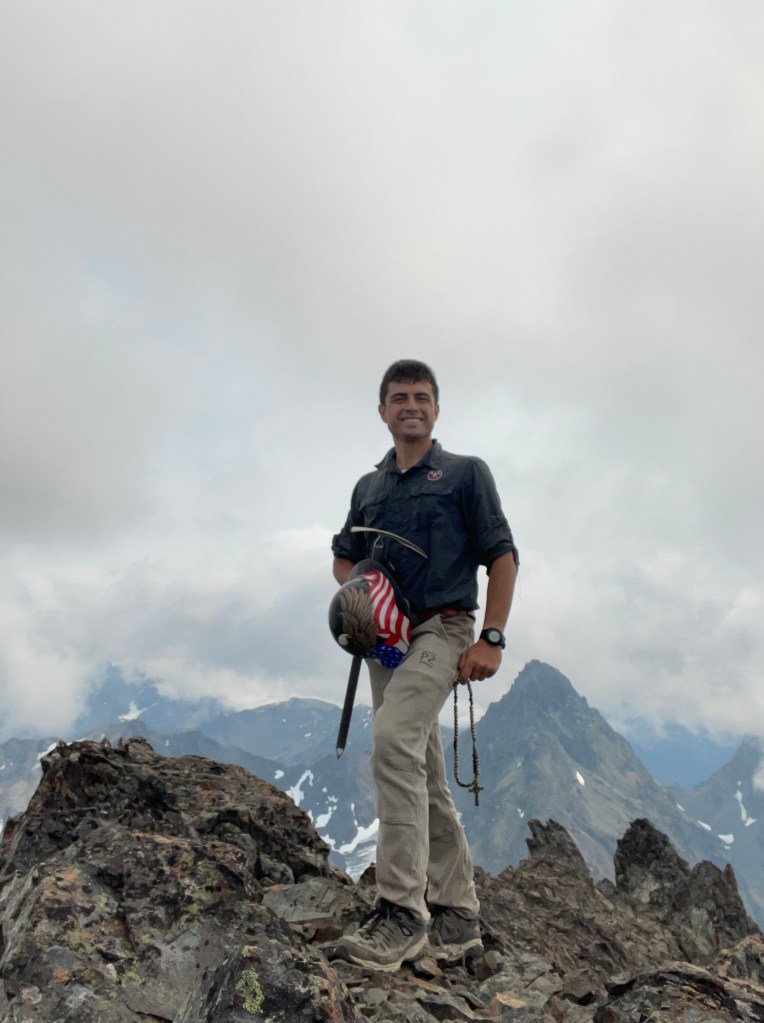
I tell new acquaintances that it is impossible to understand me without understanding that I am a Boy Scout– in all my formative years, I was shaped by the Boy Scouts of America, through participation in its programs, through the ways it formed my moral imagination and self-image, and through the adventures it granted me far earlier than I otherwise would’ve had the chance to get. My dad was in the navy, so we moved around a lot; and with him, and a long train of increasingly eccentric scoutmasters, my brothers and I grew up on the slopes of the San Bernardinos and across the Joshua Tree savannahs of the Mojave, paddling down Major Powell’s beloved Colorado beneath its mighty red-rock cliffs and following mules to the Havasupais’ ancestral land, piercing the mists of the enchanted Olympic Range and clambering to the thunderbirds’ aeries atop a live volcano the northwest indians once named Loowit. We huddled together, embracing each other in fear, as Hurricane Sandy battered our little Sea Scout sailboat across the wide Potomac, and sighed in snobby West Coast taste at the puniness of the Blue Ridge; and on a little sacred mountain in Shenandoah called Old Rag, my thoughts took me back to the summit of Mount Whitney, which I’d had the privilege a few years before of summiting with those same eccentric scoutmasters (and thank god– it got the American mountaineer’s obsessive Whitney fever out of my system very early on.) My brothers and I saw all these splendid sights before any of us turned 18.
Add to that all the Yellowstones and Yosemites and Zions and Badlands, the Gettysburgs and Little Bighorns and Jamestowns and Fort Clatsops, and all the other NPS spots our Filipina-immigrant-mom insisted we roadtrip through (so she could get to know her adoptive home) whenever our dad’s duty station changes transplanted us to another side of the country, and we probably saw a whole decades’ worth of NPS souvenir calendar pictures in real life before we graduated high school. The public lands were a cradle to us. We had no idea that most other kids, scouts or not, were not so fortunate.
Scouting also took me to a paradisical little place called Philmont Scout Ranch, where in the single most vibrant two weeks’ worth of Scouting living anyone can ever have, the OA Trail Crew program, I first hacked dirt with a mattock and learned what a backslope was and took the wilderness pledge and swore to Leave No Trace. My foreman was a crazy loud-mouthed ukulele-playing political-theory-reading half-Filipino Virginian, like me, and my young impressionable self decided to be just like him. And the conservation ethic he lived by slowly and subconsciously molded my life, even when I forgot who I was in early adulthood and left the mountains for a time.
Philmont, of course, is private land, stewarded by Scouting and accessible only to scouts. But the ethic all its visitors and especially staff learn to live by through those otherworldly scouting summers we go out to the Sangre de Cristos, teaches us to love a place because it is there, because it is ours, and because we have a responsibility to it, for we were given it by those who came before us, and owe it to those who will come after us. That is the true ethic of conservation, and of stewardship, and while it imprints quite literally on those rough folks in the Philmont-to-Forest-Service Pipeline, it does the same in spiritual senses to all the rest of us, including those who have chosen in the frontcountry of real life to go into public service. And we are pledged to practice it in all we do in life. And it is, I think, the precise same ethic we Philmonsters must demonstrate by our lives to our fellow Americans. How we treat and ought to treat the National Parks and Monuments, the National Forests and Grasslands, the National Conservation Lands, the National Wildlife Refuges, and all the rest, is the single most literal way we do that. And everybody can do it. Those lands are the common property of the American people.
I was privileged to grow up with a slew of adult role models and mentors in my life who not only took me through the great American landscapes and wildernesses, but helped me realize they were mine and all of ours, and that there was some undefinable something in a life of adventure and reflection and service that living upon them could do to you. Eventually I met Teddy Roosevelt through Edmund Morris and pieced it all together. But I couldn’t have, had it not been for those landscapes and forests and waters and shrines imprinted on my mind forever. It was my America, and it still is.
Now, I lost my mountains for a time; I wanted to be a somebody in politics and policy and spent all my time in coffee shops in front of a computer, asking for meetings with people who wouldn’t even bother to pretend to remember my name a few months later, hustling around DC and learning all the lessons of policy world the hard way. I still liked the outdoors in principle but never really spent much time in them, though I kept in touch with the public land system through routine pilgrimages to an increasing number of NPS National Historic Sites and National Historical Parks (still, I think, the most underappreciated part of the public land system, yet in my view the most important for making one realize the system as a whole really is America.) I started to become, without realizing it, one of Ed Abbey’s desk-bound men hypnotized by desk-calculators. My mental illnesses went insane, I drowned in alcohol, I got fat and hated the world, and professional failure after professional failure after professional failure made me increasingly deranged, though I still clung to some grandiose idea of myself as some kind of great noble statesman or whatever. It was bad.
Then at some point five years ago, it all cracked. After a traumatic experience that was certainly my fault, and another week of drinking in shame, I realized I never wanted to hurt myself or anyone else with my uncontrollable demons ever again. To seal my pledge I ran 18 miles through a dark March rain from Theodore Roosevelt Island down the GW Memorial Parkway to Mount Vernon, and over the next six months I got back into all the habits the teenage Boy Scout me had lived and loved, and as I returned to the mountains– Old Rag most often and most importantly of all– I began to remember who I was. That happy six-month ascent ended atop Mount Rainier and then atop San Gorgonio, the two high points of the two western regions whose mountains had forged my soul back in Scouting, where my brothers and I once had climbed. And upon my return to DC, when I climbed Old Rag again amid the yellowing of fall, my life was new.
It’s probably too much to say the public lands saved my life– Scouting, Brett McKay’s Art of Manliness, and God did that. But it certainly is true that my life was saved on the public lands.
Climbing mountains is the most trite and insipid analogy for facing personal challenges of all time, and yet it will always be the best. I’ve destroyed my career a couple of times since then, gone through valleys, broken my pledges, and all the rest. I’ve also hit new summits I’d never imagined, discovered new worlds, committed myself to higher causes and ideals I’d never thought I’d have. And all through that time I’ve gone back out to the mountains that forged my soul in youth, almost every single one of them (except the ones at Philmont) upon public land, my birthright, the birthright of all my fellow Americans.
Having a post-pandemic career in national nonprofit grassroots work– the age and condition of eternal underpaid remote work– can be a great opportunity for adventure if you make it one. So I did my best. When my brother gave me his old car with the caveat that I had to drive it home across the continent myself, I suddenly had a shot.
That summer I climbed in the Olympics, slept in the New Mexican desert, ran my first 50-mile trail race (again, at Philmont,) and visited the NPS sites where U.S. Grant and George Washington had met great shame out on the frontiers early in their lives. And over the next few summers, when conference seasons ended and when Congress was out of session and DC life slowed down, I took two-month working road trips in great John-C.-Fremont-style circumnavigations of Stegner’s geography of hope, visiting old friends in their little houses on the prairies and out on the Pacific Coast’s sleek metropoles, taking scouts out into the backcountry as an OA Trail Crew volunteer back at Philmont, and climbing as many great western mountains as I could fit in a roving transcontinental schedule. Tracing the paths of the great explorers and pioneers, continually renewing one’s sense of the vastness of American nature, gives you some perspective.
National Parks are always nice, if a little touristy, but my favorite general type of public land is the Wilderness area in a National Forest. National Forests get less traffic than parks generally, so if you’re looking for solitude I suppose it helps to be there. But more importantly, so, so many of the most gorgeous ranges in the public land system are protected by the U.S. Forest Service, and so USFS-tended Wilderness areas consistently outdo (or “mog,” as the kids are saying these days) NPS-protected areas, by a lot. My favorite kind of outdoor adventure, meantime, is a 20+-mile roundtrip, 5,000+-foot elevation gain day hike up a peak in a National Forest Wilderness area, starting with the sun and ending with the moon, spending maybe an hour or two up at the tippy-top of the vertical world, listening to the whispers on the winds, scoping the painted contours of the earth, enjoying the “sense of being the highest man for hundreds of miles around, cherished by all instinctive climbers” Edmund Morris attributes to TR. These hikes don’t hold a candle to Bob Marshall’s famous heart-stopping 50-70-mile dayhikes, but it is still nice to rush up above the clouds and be back down in time to find a big juicy burger nearby.
Just to rattle off a few, in case you’re hoping to climb something– Blanca Peak in the Sangre de Cristos, the eastern sacred mountain of the ancestral Navajo country, a nice straight uphill march til the marmots let you know you’re almost at the pointy-top summit. Mount Adams, the lieutenant ice-volcano of Washington State, where to stand atop one of the five means to be a god, gazing at the other four snowcapped gods hovering eternities away across a sea of green and beneath a sea of blue. Cloud Peak, lord of the Bighorns, where the Oglalla Lakota will tell you to sprinkle sage along the ridge, where the tarns a couple thousand feet below you shimmer glacier-baby-blue. King’s Peak, whose neighbor ridges are so dry and eroded they offer the climber one of the most fascinating panoramas of stratified geology in the American West (and so it is fitting that it is named after the first Director of the U.S. Geological Survey.) Mount Shasta, from whose summit at sunset you can watch that 100-mile shadow Clarence King saw stretch and stretch until it melts into the purple haze, and where John Muir’s salvific hot springs still boil and bubble and warm. Rocky Mountain in the Sawtooth Range, a mountain-goat’s mountain in one of the strange and slightly scary places in the lower 48 where you can find grizzly bear scat at the summit. (Perhaps the bears have personal challenges to overcome, as well.)
Another great species of adventure is the 20-mile, 10,000+-foot dayhike. There are not many of these, but let me tell you, there is something charming about the change, hour by hour, of the vegetation around you, while the panorama behind you remains the same. I have not yet climbed White Mountain Peak from the sandy trailhead in the Owens Valley, but it is the quarry I am most excited to hit.
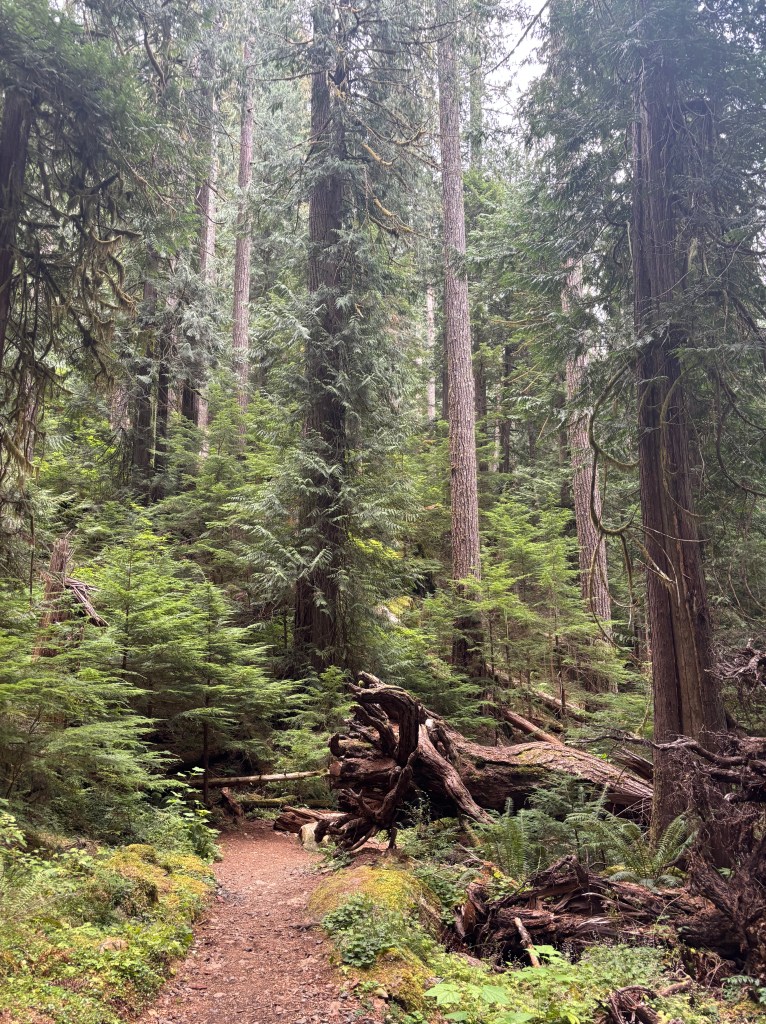
The Olympics will always be very special to me. My brothers and I went up there with the scouts quite a bit growing up, and it’s one of two geographies that my pre-Peter-Jackson (and correct) mind’s-eye-view of the landscapes of The Hobbit is based upon. (The other, of course, is Philmont!) Olympic National Park, as well as Olympic National Forest, is quite remote; no roads and few trails bisect the range, said to be one of the most rugged on the planet. To get anywhere near the peaks, you usually have to wander up a river valley for 10 miles or more, through enchanted stands of ten-foot-thick old-growth hemlocks and douglas firs and sometimes sitka spruces and western redcedars, the dark quiet of the forest pierced every once in a while by the machine-gun chatter of the Douglas Squirrel. The mossy log-strewn forest floor soon gives way to rocks and wildflowers and Alaska yellow-cedars in subalpine meadows, the old-growths replaced by true firs with their gooey purple and green cones growing straight up out of the branch.
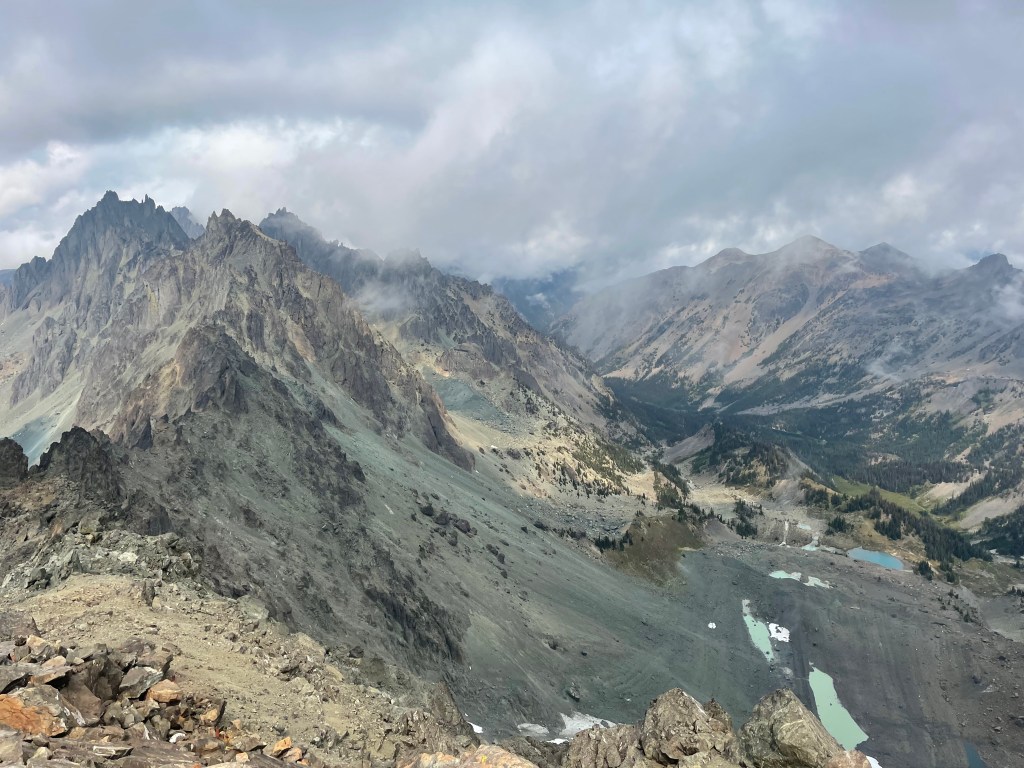
And then you reach that strange vertical world of shifting scree and barefaced rotten rock coated with the little black lichens clinging on, where the trails end and you pick your way up chutes and gulleys and faces hoping you are on the right track. Inevitably you’ll miss a turn and have to carefully lower yourself down, and turn back up into yet another wrong turn. And then you emerge atop a craggy little peak. The Olympics are unusually foggy for a western range– they are surrounded on three sides by saltwater– which makes navigation a little more mysterious, and the swift, curling mists give each photo-op mountainscape a different look every time you snap the camera. You’ll never get altitude sickness up there; but even without it, the Olympics are some of the most challenging and most rewarding little needles you’ll ever explore. They are my favorite range in America.
I had a nice little thing going there– autumns, winters, and springtimes in the intellectually-stimulating, socially-fascinating, historically-edifying world of Northern Virginia and D.C., visiting the Blue Ridge and sometimes other mountains relatively frequently, and heading west in the summertimes to enjoy the magnificent western National Forests and National Parks. I hope I get to live that way again.
In winter 2025, the new administration began wantonly firing park rangers and forest rangers, including friends of mine from Scouting. The Secretary of the Interior told the U.S. Senate that our lands were a “balance sheet.” A certain pair of U.S. Senators introduced proposals to sell off millions of acres of that “balance sheet,” and when I looked at the Wilderness Society’s ArcGIS map projecting which lands might be for sale, every single mountain I had climbed since 2021 was in or directly adjacent to a parcel on the chopping block. My blood boiled. The vast majority of my fellow Republicans failed to lift a finger, including many who fashionably identified as environmentalists, even as huge majorities of Americans shrieked in collective rage at the blasphemy.
I had never felt so vitriolically polarized on any single issue before, in 15 tumultuous years of political cognizance. Suddenly the prospect that my mountains, and the forests and deserts and rivers and prairies and all the rest, might soon be held in private ownership, no longer accessible by me or by anybody, felt very real, so nauseatingly real. It dawned on me very quickly that conservation was the cause I didn’t just want to, but had to give myself to in this season of my life. And after a chance encounter with Walt Dabney’s work, and some conversations with Philmont-to-Forest-Service friends, I embarked on a rapid self-education in public lands policy and current conservation issues, since I’d always been only an instinctual conservationist, never actually studying it in policy previously. The well-organized ecosystem of public lands radicals running SubStacks has been an incredibly helpful resource and guide in that process.
I launched an uphill campaign for the U.S. House of Representatives, in part to start organizing serious pro-public-lands Republicans institutionally. I laid the groundwork for a podcast that will work to polemicize radical public land advocacy for a specifically conservative policy-world audience. I have no idea where any of this is going to go– just that I would never forgive myself if I didn’t attempt to do something for the cause this year, with the resources and skills my career up to this point has given me, for the places and the people and the ideas that have made my America for my whole life. I won’t be able to go out west anytime soon, because of this (though Shenandoah National Park, George Washington National Forest, the numerous NPS sites around DC, and our various National Wildlife Refuges and BLM tracts around Virginia thus grow even more enticing.) But that’ll be okay.
It’s all just another mountain.
And that’s the lesson I’ve learned in all this, I guess, in personal struggles, professional odysseys, and high adventures alike. I kept climbing and climbing and climbing, trying to see some great new vision, become some perfect version of myself, trying to escape the valleys of my demons and live in the vertical world forever. And there is no feeling in the world like being at the top. But for all the better you become each time, you’re still a human being, and you can’t live on the summit; you might be a mountaineer, but long after you slide back to the valleys, the mountains will still be there, daring you to climb. I’ll never match my mountains. But I’ll always have to try.
May you never run out of mountains. I’ll see you on the trail.
-LNP
 Luke Nathan Phillips's Home on the Web
You must be logged in to post a comment.