Luke’s Blog

Debate as Sacred Ritual of American Life

LNP’s Address to the National History Academy’s high school summer honors program, July 6th 2022

(Fourth of July Oration) (Not as good as Frederick Douglass’s) (Dedicated to someone who makes me debate with myself)

I have often heard said, that America is an idea; a set of pristine principles, an aspirational truth, a great becoming as-yet-unrealized. I have often heard said, that America is a place, a great nation with a great heritage, a lived experience in historical time. There are good and wise men and women, left and right, young and old, who have argued for either of these conceptions—America is a nation, America is an idea—and have brought forth great arguments for either.

My own prejudiced opinion is that America is a nation that believes itself to be an idea, and that from that reality sprouts forth all the messiness and beauty, all the rancor and grandeur, all the banal simplicity and hypocritical vice and redemptive glory that has characterized American life in every decade and will mark American life for every decade yet to come. There never was a golden age and there never will be one; we’ve always been like this and always will be. That’s not to say that things don’t change, or that history’s just one darn thing after another. But it is to say, that if you want to understand America, and that impossible-to-define concept everyone has an opinion about, American identity, you have to look to the past, and be prepared to see the past in the present, the present in the past, and everything in between.

So, “a nation that believes itself to be an idea.” How does that even emerge? What does that mean for us nowadays—should we dislike ourselves, or dislike people who don’t dislike themselves? Should we blindly celebrate ourselves, and be blind to those who decline to celebrate? Don’t we need a consensus, a coherent set of general propositions or abstract truths or civic touchstones that everyone can agree are good and worth venerating, and when we’ve found such a consensus, is it not our right to insist that everyone, every American if they really are an American, agree to that consensus as an absolute minimum and an absolute baseline for participation in the American family and our glorious national community?

I, for my own part, don’t think so. We clearly do not have that now, and have not had that sort of consensus for most of living memory. We didn’t even have any deep consensus in the shocked weeks after airplanes hit the World Trade Center and the Pentagon in September 2001, or in the shocked weeks after COVID-19 case counts climbed and governments around the United States commenced lockdowns as the most prominent pandemic of our times spread all over this broad land in March 2020. And the more we look at any of the supposed “eras of good feelings” or “holidays from history” commonly remembered for their supposed unity, the more the true divisions and suppressions and dissensions and decadences of those times remind us, if we care to listen, that our divides today are really nothing new.

Somehow, America has gotten by; somehow, every great achievement and notable event in American history, has happened not by some collaborative emergence of consensus, where everyone got their input and agreed with the final product, and then pushed forward pragmatically in unison to make things happen. No, those great events and achievements have taken place amid, and thanks to, pitched and screeching battles, cast against apocalyptic times, the leaders and citizens of every moment imagining, sometimes rightly, that the very soul of democracy—the very fate of the republic—the very dream of the nation—hung always in the balance, their personal acts and convictions having a real meaning for history, their duty as citizens and as leaders and as activists and as prophets compelling them always to fight with fury for the things they believed in most.

That is, America has always been something of a process; a strange and nonsensical system whose parts, believing and practicing as they did incompatible things, have duked it out against each other in every moment in the past. Sometimes, some of those parts have come a little closer to long-term victory than others; more often they’ve settled into some more-or-less workable compromise with the other parts, and that has begun in time to look more like a consensus than it ever actually was. And in due time these compromises break down; they cease being useful to resolve the problems they once resolved, or new problems arise which prior generations simply cannot wrap their minds around. And when the façade of order and unity finally becomes too contradictory and dysfunctional to maintain, and comes collapsing down, then all that is solid melts into thin air, and the destructive and creative whirlwinds of American politics and society are let loose, and sometimes great geniuses and oftener great movements wring new light from the storm. They speak new orders into existence; by the sweat of their brows and the witness of their hearts they renew America in the times America seems lost, gone, forsaken.

You could even think of America as something of an ongoing great debate—a great debate that is not between any specific contrasting principles, nor between any specific lived realities, but is something bigger; a great debate that is always ongoing—that never ends, in which there can be no final victories, and no final defeats, where every generation renews the old flames—a never-ending great debate whose participants are every single American, every single one of the American people, whether they’re recognized as such or not, whether they know they’re debating or not, whatever the issues and the factions and the sects and the parties and the divisions of the time might be. In this debate, one’s life is an argument, one’s actions are a comprehensive speech, one’s arguments and speeches are little reminders that America—a people in motion, an unfolding revolution, a grand conversation—is always a thing in process. We have inherited things, ideas and experiences, and they have made us what we are, and we see them all around us. But we also are always building something new, pushing the project ever further into the future, practicing in our actions those great political arts which every generation of Americans has learned in its own way.

Some have written this into our political theory. When James Madison, John Jay, and Alexander Hamilton wrote the Federalist Papers, they looked at this dynamic. When Alexis de Tocqueville described the America he saw, he used this dynamic. When John Dewey tried to establish a new system of education for democracy, he looked at this dynamic, and all sober American political theorists and political historians—whatever their convictions and prejudices—have had to grapple with the fact, that the American system of politics is constantly integrating from the bottom up, building new coalitions from disparate blocks, establishing rules and orders and systems which assume and aspire to fairness and impartiality across the pluralist hearth. It is, after all, our national motto—E Pluribus, Unum—From Many, One. Every American political and social institution worth its salt—from Congress and the legislatures and the federal government in general, to the political parties, to the great civil society institutions and voluntary associations and religious movements that enrich our common life, to fan clubs and advocacies to local communities, to the university itself—operates, in some way or another, in deference to this logic, and when these institutions fail to so operate, they deservedly lose trust among large sections of the public.

So America is in a real sense a debate; every American institution is premised on debate; debate is in a deep and public sense, what we do. More than even voting, it defines the American political experience. It has been our national experience in every major conflict, crisis, division, consensus, and opportunity in our history. And it doesn’t just happen at the highest levels, at grand ethereal heights of power abstract to everyday people. It happens at every level of society, including our own, and we all participate in it in some sense—whether by engagement, understanding, anger, or avoidance, is our own choice—every day and on every issue and across our lives. Sometimes we do it badly, sometimes we do it well. But we do it, and so do all our fellow Americans, just as we always have.

And so debate in itself is something of a sacred ritual for Americans—an expression of the very best qualities of our national soul, our mutual fellowship and our habits of persuasion and our standing for things higher than ourselves in the public eye, by which we create even higher things in cooperation and competition with our fellow-citizens; a glorious moment and process where the life of American principle and nationhood and soul, intersects with the day-to-day life of every American, no matter where they’re from; where every American is given the chance to be an equal participant, with every other American, on the field of public discourse.

It has been frequently remarked, that it seems to have been reserved to the people of this country, by their conduct and example, to decide the important question, whether societies of men [and women] are really capable or not, of establishing good government from reflection and choice, or whether they are forever to depend, for their political constitutions, on accident and force.” That was Alexander Hamilton, as the American people in 1788 set out on their great debate on whether there would be a Constitution; on whether there would be a union. When we think of debates in American history, we often think back to those heady days—the Constitutional Convention and its Ratification aftermath—which, it is true, brought forth some of the best argument and oratory and theory and organizing in our history. But when we consign the greatness of debate to that hazy heroic past, a past plastered in paint in our National Archives and our lazy memory, we forget that the power of those men, is our birthright as Americans. Every generation since, every cause since, every movement since—including the generations and causes and movements that ended slavery and saved the union, that reformed and modernized our country as we entered the modern age, that fought the fascists and communists and laid the foundations of world leadership, that brought equality before the law into a deeper lived reality than Americans had ever known—every generation and cause and movement since, has had and has used that same power of debate and deliberation, that ability to organize a free democratic society for higher ends and purposes, for the purposes of their own day. Some had to spend much sweat and sometimes blood for their causes. But their power and habit and process to debate was integral to their ability to organize politically, and every party convention, legislative session, national conference, town meeting, fan club bylines-drafting session, and national student history honors program has in some real sense beat with the living spirits of 1787 and 1788 up to this present moment. They had that power, and you have that power too.

So I exhort you all, to undertake your citizenship in this strange and contradictory and innocent and hypocritical and infuriating and ennobling and wonderful and terrible and glorious American experience of ours, with an eye to the past and an eye to the future, and two hands gesticulating wildly in the grand debates you’ll win and lose, in this great never-ending debate that is the United States of America. You are at the tail end of a great tradition, pushing it forward into an uncertain future. Act worthy of your heritage; act worthy of posterity; act worthy of yourselves. The great debate will never be resolved, and will never stop, and so long as it goes on America will live; and none of us can ever really escape it. So let us go forth and debate, with the enthusiasm, the charity, the humility, and the magnanimity which, at the end of the day, are the prerequisite foundations of true eloquence.

Dispatch from 14,000 Feet

[Braver Angels Member Newsletter, Aug. 15th 2021; Read for KTAH Jan. 13th, 2022]

A few weeks ago I was climbing mountains out west. My Braver Angels Debates colleague Clif Swiggett had invited me to climb Tahoma—Mount Rainier—with his sons and their friends, and so I tagged along, following the benevolence, grit, and expertise of these far more experienced mountaineers up one of the most beautiful and prominent mountains in the United States of America.

My trail reading that trek, which I finished while strapping on crampons for our glacier ascent under the glowing northwest summer moon, included German sociologist Max Weber’s “Politics as a Vocation,” a hundred-year-old lecture that hasn’t aged a day. 

Included in its closing lines is an admonition that those with a calling for public life “must arm themselves with that staunchness of heart that refuses to be daunted by the collapse of all their hopes. And, if they’re serious about the business, be “certain that [their] spirit will not be broken if the world… proves too stupid or base to accept what [they wish] to offer it.”

I took this punk-rock-ish advice– to love life, to be undaunted by failure, and to do work for work’s sake– up Tahoma with me. On we crawled through the darkness on ice and the thinning air, up those majestic crags and across the jagged frost-fields and wobbling scree, the lights of Seattle glowing on our right and the full moon beaming from our left, as we traversed steadily up the strange vertical world that greets those who climb great heights. We reached Columbia Crest around 5:30 a.m., as sunlight returned to illuminate the world.

We were greeted not by the narrow, windswept, sawtooth-pointed promontory one is conditioned to expect atop a great western mountain, but by a vast flat volcanic summit whose chief view was itself. There was no single peak. There was nowhere—amid the multiple high points nestled around the top—to spin around and behold a panoramic view of Puget Sound and the Cascades. The very size and prominence of Tahoma that draws so many thousands up its slopes—“Why are you climbing it?” “Because it’s there!”—make the view from the top far less grand than what I’d imagined it might be.

On the slushy slog down in the morning’s melting snow, as we belayed across widening crevasses, it occurred to me that Weber might be analogically helpful here. 

Bluntly, Tahoma has a disappointing summit, the most disappointing of any I’ve ever climbed, especially when compared with the thrill of the ascent. Sometimes (and I’m very guilty of this) we inhabitants of the modern world go to the mountains looking for something and expect we’ll be hit with profound insight or meaning or whatever at the top. 

And so the dry reality that outdoor insight doesn’t just happen by some primal magic logic of nature can be disillusioning. All the more so, when a mountain you’ve longed to conquer for the better part of your adult life turns out to have been better as a journey than as a destination—when at its peak, you don’t even know what you came to find.

That’s not just life or just mountaineering. That dry disappointment in victory, says Weber, is politics as well. It is all of public life, including the public life of those of us who, in good faith, strive day by day to elevate the public discourse and demonstrate for our fellow Americans a better way to live in our democratic republic, to find new heights in our common life.

It’s not just that you’ll face defeat every once in a while. It’s that victory itself is never total; achievement is never final; progress is never complete, and simply cannot be, for all human things come to an end. The only true victory is to be, by your own conduct, a beacon of honest hope in a torn gray world, come whatever may, in victory or defeat.

Those with a vocation for politics, as Weber might have it, or a passion to change the world or serve our country, as we might have it, must always be prepared to know that they may lose, and fight on anyway. Holding oneself responsibly—as a steward of virtues our fellow Americans sometimes forget, but of which they must always be reminded—demands nothing less. And in the uphill fight of spirit we’re all pushing forward as Braver Angels, that fidelity is everything.

I’m back east now, back to work. See you on an America’s Public Forum or Debate soon. And may the ascents and summits of your life reveal their meanings to you in time.

— Luke Nathan Phillips, Braver Angels Publius Fellow for Public Discourse

The Killer Apes of Mount Rainier

Author’s Note: A version of this piece first appeared at The American Conservative on August 28th, 2020.

In Review: “Devolution: A Firsthand Account of the Rainier Sasquatch Massacre,” by Max Brooks, 2020

By Luke Nathan Phillips

It is only human to be scared of the dark, although that doesn’t stop some of us from occasionally finding ourselves wandering alone around the woods without a light, on a moonless night, for no particular reason. The world changes in these sojourns. Your night-vision perks up, only a little, but discernibly. Your hearing does as well, and you realize just how loud nighttime nature is. You’re more sensitive to the texture of the ground beneath you, to smells you hadn’t noticed before; shadows seem to twist and turn as though alive, and if your mind’s overworking itself, you might feel you’re being watched. These kinds of nights, I repeat to myself that there’s nothing else out there following me, even as I quicken my pace until I’m back in the safety of a well-lit spot. Just in case, of course.

One of the mind’s-eye darkness-monsters I’ve feared since my youth as a Boy Scout in the Pacific Northwest has been, predictably, the sasquatch. The primal fear that some damn dirty ape might be stalking me amid the firs and hemlocks was never particularly well-defined, though, beyond the vague, hairy, hulking figure of cartoon lore. What, exactly, was I afraid a sasquatch would do to me, if I ran into one?

It is to this serial nocturnal wanderer’s great anxiety, then, that the inimitable Max Brooks has given us a vivid, visceral depiction of what a sasquatch might do to you. He vividly and realistically depicts his characters’ split-second reactions when, wandering around in the dark woods of the high Cascades, they see things in the night, but can’t be sure of what they saw, or that they saw it. It’s a feeling we nighttime wanderers have all had, and Brooks captures it eerily. That realism pays dividends; it makes easier the suspension of disbelief required for reading a ‘Bigfoot-Destroys-Town’ story, in this case a story that is not just believable or entertaining, but even morally compelling.

Devolution: A Firsthand Account of the Rainier Sasquatch Massacre is, more or less, what its name suggests. It’s a docufiction, found-footage-style account. Brooks informs us that he was tipped off by the brother of the missing Kate Holland to her last testament—a diary she’d kept when she moved to the tiny, idyllic, ecotopian town of Greenloop (population: 11) on the eastern slopes of Mount Rainier. Shocked by the journal’s contents, Brooks interviewed Kate’s brother, as well as the park ranger who led the first search-and-rescue team into the ashen ruins of Greenloop, where her team had discovered 18-inch humanoid footprints, torched homes, shallow graves, and the said diary. Brooks presents the journal chronologically, appending its entries with snippets of the interview transcripts and, interestingly enough, maxims on war from literary history and haunting quips on ape behavior from famous primatologists like Frans de Waal and Jane Goodall. For good measure, other old bits of sasquatch lore—especially the ‘goblin-beast of Idaho’ story recounted by Theodore Roosevelt in The Wilderness Hunter, and the Ape Canyon legend—make their appearances as well.

All these references are arrayed to present a modestly believable theory of the origins of the sasquatch, as a primate.[i] The real-life giant ancient ape of the Asian mountains, Gigantopithecus blacki, is cast as having been an upright walker, not unlike the smaller hominids with which it shared the earth. Those hominids, first Homo erectus and then us, Homo sapiens, evolved alongside Gigantopithecus throughout the Pleistocene and Holocene epochs. When glaciation exposed the Bering Land Bridge tens of thousands of years ago, modern humans crossed from Asia into North America, and so did the apparently-not-yet-extinct Gigantopithecus—the sasquatches. As Kate’s brother muses, “what if… they weren’t just co-migrating along with us? What if they were hunting us? …What if we were stalking the caribou while they were stalking us?”

Early on, in a representative sample of the book’s sometimes maniacally black humor, a despondent and depressed Kate partakes in a welcome-to-your-new-home meditation session with one of the town’s founders. The rich, beautiful, tanned, British-accented, well-connected former model Yvette Durant, is a credentialed ‘psychosomatic illness therapist’ who daily streams virtual ‘integrative health yoga’ sessions to her fans around the world from their secluded, idyllic alpine paradise. After some breathing exercises and new-age gobbledygook, Yvette prods Kate into imagining rushing into the loving arms of ‘Oma,’ the ‘guardian of the wilderness.’ “Feel her energy, her protection. Feel her soft, warm arms around you. Her sweet, cleansing breath surround you.” Kate, entranced, asks if Oma is the same as Bigfoot or Sasquatch; Yvette explains that Eurocentric white men perverted the mythic gentle forest spirit into a hideous monster, “like everything else our society has done to what came before it.” In due time, Yvette does feel those soft warm arms and sweet cleansing breath, while Kate barely escapes them.

The symbolism here—an upper-middle class enclave whose residents seek to live in harmony with nature, suddenly exposed to the pitilessness and fury of the nature which they’d come hoping to live harmoniously with—is rich and delicious. Greenloop has, indeed, forgotten the gods of the copybook headings, and those old gods, soon enough, make themselves known.

Mount Rainier erupts, and as the lava flows slide to Puget Sound they kill thousands of Washingtonians. Thousands more are stranded in communities in the Cascade foothills. Refugees flee to Vancouver or Portland when they can; the majority, trapped in the Seattle megalopolis, soon devolves to food rioting and urban guerilla warfare while the U.S. military and local emergency services are mustered to render aid. Here, Brooks’s wargaming most closely resembles that of his earlier bestseller, World War Z: An Oral History of the Zombie War, in examining the social and political effects of unforeseen disasters. But this is all background noise, which Kate and the other residents of Greenloop listen to on the radio whenever they can catch a signal. The lava slides mercifully avoided Greenloop, but have blocked off all its access roads by which the townspeople might escape. And with Washington State and America itself in chaos, there’s no real hope that overworked rescue workers will notice a tiny, isolated, eccentric town deep in the mountains anytime soon. The denizens of Greenloop are low on food, unarmed, unprepared, and on their own.

That’s when Kate starts seeing things. Strange, rancid smells in the woods while she’s gathering berries, and the feeling that she’s being watched. A boulder down the road, as she paces along alone in the dark, seems to move. Strange howls in the night, unlike any she’s heard before. The shattered carcass of a mountain lion, surrounded by footprints. Nobody believes her but her long-suffering husband, Dan, and the sage-like artist Mostar, until the whole troop of sasquatches (yes, Brooks insists on using the technical term for a group of apes) investigates the town at night, the dumbfounded residents watching from indoors. Even then, some of the townsfolk—a retired professor, some vegan advocates, Yvette and her suave husband—convince themselves that the apes might be harmless, even friendly. “I seem to recall that most hominids are herbivorous in nature,” assures the professor. Then the first barrage of rocks comes, and Greenloop’s fate is sealed.

In a nutshell, the journal tells the story of a series of devolutions. First is the devolution of the natural order, as the volcano-displaced sasquatches return as apex predator and hunt the humans who’d technologically marginalized them for millennia. Then there’s the devolution of decadent, advanced civilization to chaos and barbarism—Greenloop is a high-tech, environmentally-conscious, socially cosmopolitan community of the sort you’d imagine Davos and TedX types to hawk as humanity’s inexorable future. It lies in smoking ruin at the end, its inhabitants devoured by primeval monsters, its pretenses burnt on altars of meat and stone.

Then there’s the devolution of human nature amid the breakdown of moral and temporal order; Greenloop’s posh, high-status funder-founders, the Durants, devolve into mindless, drug-addled wraiths as they lose control of the crisis and faith in themselves, and then are gruesomely consumed. Kate and the other suburban middle-class failures devolve, too; they lose their romantic illusions, learn to fight and kill the beasts, and tap into the primal, amoral side of the human spirit reducible neither to selfish genes nor to social constructs. Both transformations are devolutions, with different moral weights. The Cassandra-like foresight and eventual sacrifice of Mostar, who is heavily implied to be a Bosnian war refugee, and the hardiness and eventual survival of Palomino, who is heavily implied to be a refugee Rohingya child (Kate compares her eyes to Sharbat Gula’s,) cast further aspersions at modern elite western decadence. Those who carry tragedy within themselves are more fit to stave off tragedies than those who’ve never suffered.

The gratuitous blood and gore certainly helps drive the point home. Heads are pulled off, bones are smashed to bits, uneaten body parts are hurled at shocked survivors. Sasquatches crush human skulls with the balls of their humanoid feet, and rip out townspeople’s guts in carnivorous orgies. Nothing chimpanzees don’t do to smaller monkeys in real life, of course. The townspeople, meanwhile, bash out some of the sasquatches’ brains, and urinate on others’ corpses in front of their enraged fellow apes.

The line between man-vs.-beast and man-vs.-man is muddied and obscured, very effectively. The reason Mostar’s background as a survivor of ethnic warfare helps her and the town here, of course, is that the troop of sasquatches is an organized foe, capable of planning and executing strategies to achieve its hungry aims—and from rock bombardments to keeping human captives alive as rescue-bait, they do just that, to deadly effect. But the sheer savagery of the warfare—annihilationist rather than attritional, each faction seeing the other as either an existential threat, or an inferior and tasty dinner, to be destroyed entirely—brings it back to the world of the food chain and the natural order’s cruelty.

Survival, rage, hatred, revenge, things we like to think of as irrational, illiberal, and outdated in our cozy modern world, rule this fight. In plowing through the last few (admittedly overdone) chapters of climactic battles between wild man and wild ape, it grows less clear whether you’re reading about a hunt by one species of another, or a battle between vengeful equals. They’re not so distinct, at root. A quick reflection on wartime news from the disordered corners of the earth suggests that this is quite relevant to us today, even amid rival clans of homo sapiens alone. A quick reflection on the long Paleolithic history of human warfare, and its historical aftermath in the last 10,000 years, suggests that that is exactly the point Brooks wants to drive home.

This is not just an action thriller or a survival narrative or a psychological horror story. Beyond those, it is a sly reminder to we moderns of what, in the end, human beings are, whether we like to admit it or not. It serves Brooks’s general purpose—recall, he’s a fellow at West Point’s Modern War Institute and the Atlantic Council’s Scowcroft Center—in using speculative fiction for wargaming, and the education of strategists. The central concern of Devolution, indeed, is devolution—what human beings can become when order breaks down and violence breaks out. After all, the majority of wars in the last several decades, as well as many recent bouts of civil unrest and political turmoil, have been more about the breakdown of internal order than the relations of states and empires. The reader of Devolution is prodded into some uncomfortable questions. If I were thrown into that maelstrom, with sasquatches or with sapiens, could I survive? Could I really be civilized on the other side of that? Beneath all our order and civilization, are we really so unlike the killer apes?

 And Brooks concludes the story with some interesting speculations on that. Kate Holland, it seems, survived the last recorded onslaught of the sasquatches, along with Palomino. Brooks and Kate’s brother speculate on their eventual fate, as their bodies were not found in Greenloop’s ruins. Did the sasquatch troop’s survivors regroup and strike again, carrying off and feasting upon the last two humans? Did Kate and Palomino strike off to make their way back to civilization on foot, only to freeze in the mountain snows? Did they, perhaps, make it all the way back to some refugee camp, and simply have not been identified yet?

Or did Kate’s devolution go further? “What if those poor dumb brutes flicked a switch in Kate that’s waiting in all our DNA?” What if Kate and Palomino, emboldened and awakened by some new primal fury, went out to hunt down the rest of the sasquatch troop, now that they knew how to kill them? What if “by some miracle they kept stalking those things, killing them one by one?” Primeval sasquatch genocide is a laughable thought on the face of it, of course, but knowing what we do about human nature, is it so hard to imagine?

The essential questions Brooks raises in Devolution are not far off from the questions analyzed by philosophers of human nature. Brooks’s quiet conclusions seem, on the surface, amenable to the evolutionary psychologists over at the Intellectual Dark Web, and in some ways they are (though for my money, Steven Pinker’s and Jonathan Haidt’s whiggish historical sunniness and faith in bounded rationality miss the deeper, tragic lessons Brooks conveys.) Devolution may appeal as well, for obvious reasons, to the atavistic and carnivorous likes of Jordan Peterson and Bronze Age Pervert, though Brooks’s choice of a female protagonist serves to confound those who’d impute reactionary ideas into his story. The majority of pantheistic environmentalists, of course, might broadly concede Brooks’s naturalistic pessimism, while rejecting its deeper metaphysical conclusions; one can imagine strained, hucksterish reviews analogizing the sasquatch attack to climate change or coronavirus.

But recall again Brooks’s job: he’s a military analyst, a fellow at various strategic think tanks. He tries to help American military planners think more clearly and creatively about the human terrain underlying political and military reality, to avoid the ideological straitjacketing and techno-determinism that have hamstrung our military planners in decades past. If sasquatch-attack survival-horror-thriller is not the most predictable way to teach that, it is certainly a creative and compelling way to do so. Devolution is not ultimately about how to best fight wars or defeat counterinsurgencies or promote peace. It’s instead a haunting reminder of what human beings are, in all our complexity and contradiction, and are capable of reverting to, lest we delude ourselves otherwise.

So be careful next time you’re hiking near Mount Rainier, or doing anything else in human society. There’s killer apes out there.


[i] Brooks goes so far as to invent a fictional textbook field-guide, Steve Morgan’s The Sasquatch Companion, and cites it liberally as a source.

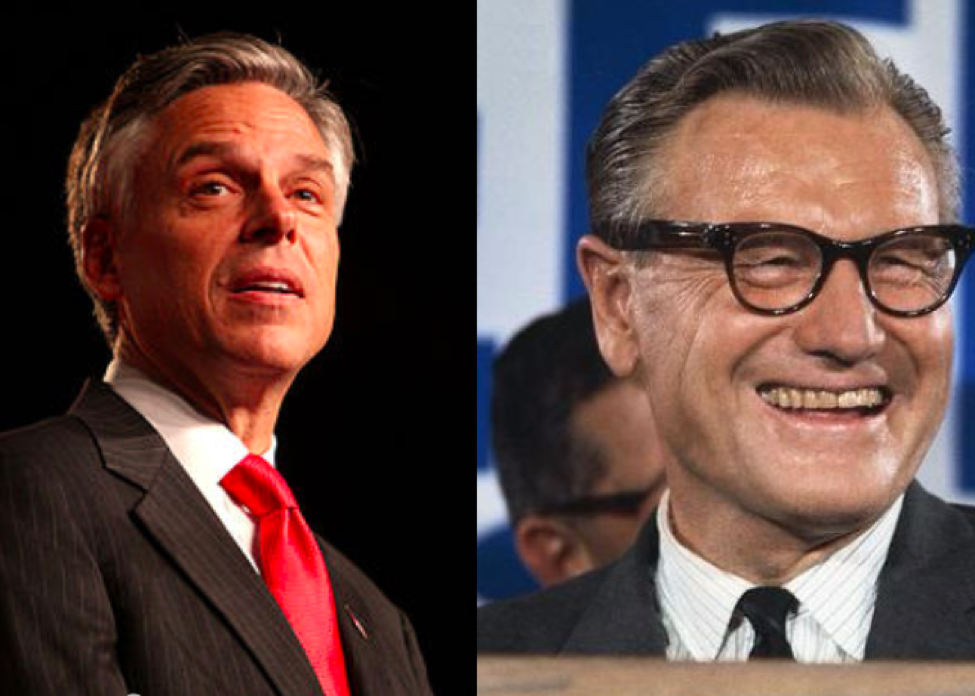
Parallel Lives of Nelson Rockefeller and Jon Huntsman, Jr.

HuntsmanRockefeller

Note: I wrote this piece a few years back and published it at the now-defunct The American Moderate website. Given that Governor Huntsman is, as of August 2019, planning to retire from the Russian Ambassadorship and presumably will reenter national domestic political advocacy, if not domestic politics in Utah itself, I figure it is useful to have it re-published here on my blog. -LNP

Word on the street in Utah has it that the Beehive State’s favorite living son, former Governor Jon M. Huntsman Jr., will undergo his confirmation hearing for the Russian Ambassadorship very soon, possibly arriving in Moscow as early as mid-September. When he gets there, Huntsman will be adding another distinguished post to his long and ongoing career in public service in the national spotlight, which has included the Governorship of Utah, service to four Presidents (Trump will be the fifth,) and his own 2012 run for the Presidency. Many are wishing the best for the Ambassador, and at age the ripe young age of 57, it can be reasonably assumed that he has ambitions for further influence in public life. But in the opinion of this author, Huntsman should take heed of the life of another long-term, bipartisan, moderate Republican public servant from the 20th century, to minimize his mistakes and maximize his usefulness and influence- Governor of New York, subcabinet secretary, and Vice-President Nelson Aldrich Rockefeller.

Nelson Rockefeller is typically remembered as a failed presidential candidate and a lingering holdout of a lost liberal Republicanism, but his long career in public service should overshadow his otherwise eccentric flights of wannabe presidential fancy. A scion of the great wealth of the Rockefeller clan, a notable philanthropist, and a modestly successful businessman in the oil industry, Rockefeller entered public service in 1940 and went on to serve four Presidents in cabinet or commission roles, including being Dwight Eisenhower’s Under-Secretary of Health, Education, and Welfare and as Gerald Ford’s Vice-President. He served as Governor of New York from 1959 to 1973 and ran for the Presidency three times, losing the GOP nomination to the more pragmatic Richard Nixon in 1960 and 1968 and to the heavily conservative Barry Goldwater in 1964. He was the major voice for moderation in Republican politics throughout the “thirty years’ war” for the soul of the GOP between conservative and moderate Republicans that ran from 1950 and 1980. His failure to forestall the transformation of the GOP into a uniformly conservative party was one of the pivotal political events of the late 20th century.

Ambassador Huntsman should look to Vice-President Rockefeller’s legacy, not least to see where “Rocky” failed at his great quests, and achieved lesser stature and influence than he otherwise might have. Huntsman has taken on himself some of those same quests, and if he is to succeed at them in the interests of the country, he must not make the same mistakes Rockefeller did.

To begin, Huntsman and Rockefeller both came from great wealth. Huntsman’s father, Jon M. Huntsman Sr., is a billionaire and the founder of Huntsman Corp., a titan in the chemicals manufacturing industry, and of the Huntsman Cancer Foundation. Indeed, Jon Huntsman Jr. has based much of his political career and influence in Utah state politics off of the wealth of his father, and his father’s net worth is probably one of the main factors explaining why Huntsman Jr. can speak the language of Republican moderation without having to please more socially conservative, fiscally dogmatic GOP donors. Additionally, Huntsman counts among his ancestors two major figures in the history of the church of the Latter-Day Saints.

Nelson Rockefeller’s family origins were even more opulent and influential- his tremendously wealthy father, John D. Rockefeller Jr., was himself the son of the legendary figure John D. Rockefeller Sr., who defined both the Horatio Alger mythos of the late 19th Century and the contours of the American oil industry in the early 20th Century. Rockefeller’s mother, meanwhile, was daughter of the powerful progressive-era Republican Senator Nelson Aldrich, one of the “Big Four” Republican Senators and a major sponsor of the efforts to create the Federal Reserve. Rockefeller’s privileged youth was one of the main reasons he was able to sustain the political career he did, as well.

The young Jon Huntsman was perhaps more eccentric than the young Nelson Rockefeller- Huntsman evidently dropped out of high school to play keyboard in a rock band called “Wizard”- but both received Ivy League educations (Huntsman at UPenn, Rockefeller at Dartmouth) and rubbed elbows with national political elites while traveling frequently, thanks to their privileged parents. And for various reasons, both seem to have developed temperaments inclined towards bipartisan public service and pragmatic problem-solving by an early age, in both domestic policy and foreign affairs. One can speculate on the old WASP-y cult of public service that animated the “Eastern Establishment” Rockefeller was raised in, and the Mormon Church’s communalistic ethos and Huntsman’s own formative experiences in the Boy Scouts of America. Regardless, compare Rockefeller’s quip in an interview concerning why he accepted Gerald Ford’s offer of the Vice-Presidency, with Huntsman’s rebuke of Mitt Romney in a 2012 GOP presidential debate-

“I felt there was a duty incumbent on every American who could do anything that could contribute to a restoration of confidence in the democratic process and in the integrity of government…” –Nelson Rockefeller

“I was criticized for putting my country first… [Romney] criticized me for serving my country in China, yes, under a Democrat, like my two sons are doing in the United States Navy… I will always put my country first…” –Jon Huntsman

Meanwhile, Robert Connery and Gerald Benjamin’s analysis of Rockefeller’s political style as Governor of New York could be copied verbatim to describe Huntsman’s style as Governor of Utah:

Rockefeller was not committed to any ideology. Rather, he considered himself a pragmatic problem solver, much more interested in defining problems and finding solutions around which he could unite support sufficient to secure their enactment in legislation than in following a strictly conservative or liberal course. Rockefeller’s programs did not consistently follow either a liberal or conservative ideology.” –from Rockefeller of New York: Executive Power in the State House.

 Of course, it could be argued that most any politician outside of the Ted Cruz/Barry Goldwater wing of the Republican Party or the Bernie Sanders/George McGovern wing of the Democratic Party would claim similar mantles of policy pragmatism and public service. But Nelson Rockefeller uniquely lived up to those mantles, as has Jon Huntsman, as I hope is made clear through the following summations of their lives.

Rockefeller first entered national public service in his early 30s, appointed by President Franklin Delano Roosevelt as Coordinator of Inter-American Affairs. He had previously worked in New York county government and had carried on his business career with various petroleum companies. Throughout the Second World War, Rockefeller worked on U.S. diplomatic and public diplomacy efforts in Latin America, and was appointed Assistant Secretary of State for American Republic Affairs in 1944. (President Harry Truman would fire him from this role, and later appoint him to work on his international development efforts in 1950.)

After a brief hiatus from public service, Rockefeller was appointed by President Dwight Eisenhower to be Under-Secretary of the newly-formed Department of Health, Education, and Welfare, before transferring back to foreign policy when he was appointed as Eisenhower’s Special Assistant to the President for Foreign Affairs. Around this time, Rockefeller met Henry Kissinger, and the two would be close partners until Rockefeller’s death in 1979.

In 1958, Rockefeller was elected Governor of New York, an office he would hold until 1973 and a bully pulpit from which he would launch multiple campaigns for the Presidency and advocate for “Rockefeller Republicanism” against the growing insurgency of conservatives led by Barry Goldwater and Ronald Reagan. Rockefeller proved himself to be a pragmatic activist in state domestic policy, equaling the contemporary Governors of California Pat Brown and Ronald Reagan in both Brown’s infrastructure and education spending and in Reagan’s emphasis on law-and-order politics and police expansion. His state agenda looked something like a combination of Lyndon Johnson’s investment programs and Richard Nixon’s governance reform efforts.

Over the course of his governorship, Rockefeller ran for President three times. Each time he would strive to influence the direction of the Republican Party, to keep it on the liberal/progressive/moderate track and off of the conservative track Barry Goldwater represented. In 1960 he signed the Treaty of Fifth Avenue with GOP presidential nominee Richard Nixon, aimed at improving the GOP’s civil rights stances. Rockefeller’s speech at the 1964 Republican Convention encouraged Republicans to repudiate extreme conservatives, even as Goldwater announced that extremism “in defense of liberty” was “no vice.” After losing the nomination again to Nixon in 1968, Rockefeller worked to influence Nixon’s domestic agenda towards something more like his own agenda in New York.

Rockefeller worked informally in the Nixon Administration as well, serving on study commissions of Latin America and domestic water quality. After Nixon’s resignation, Rockefeller became chairman of the Commission on Critical Choices for Americans, which was a bipartisan group aimed at studying and promoting new national initiatives in domestic and foreign policy. President Gerald Ford appointed Rockefeller to be his Vice-President, and Rockefeller served in that role through the end of Ford’s term, despite being widely-regarded as a relatively unimportant and uninfluential Vice-President. His career in public life ended, more or less, with his receipt of the Presidential Medal of Freedom in 1977. Rockefeller died in 1979.

In many ways, Jon Huntsman’s career in politics, government, and public life has generally followed similar contours to Nelson Rockefeller’s, and Huntsman has even pursued similar goals and aims in a dramatically different political environment, both in the Republican Party and in the nation as a whole. Huntsman entered public life early on as well, serving in Rockefeller’s great rival Ronald Reagan’s White House as a staff assistant. He entered national public service at a similarly young age to Rockefeller, becoming at age 32 the youngest United States Ambassador in over one hundred years (representing President George H.W. Bush’s Administration in Singapore.) After a hiatus from public life after the Bush Sr. administration, Huntsman was appointed by President George W. Bush to be Deputy United States Trade Representative.

After serving in the Bush Administration, Huntsman ran for Governor of Utah and won, assuming the office in 2004. As Governor, he pushed for a variety of liberal and conservative reforms, on taxation, environmental regulation, immigration reform, and abortion regulations, “sin taxes,” and LGBT issues. The Huffington Post has described Governor Huntsman, in his tenure in the Governorship, as “a conservative technocrat-optimist with moderate positions,” while Politico calls him “moderate by temperament, conservative by ideology, and pragmatist by approach.” He definitely is a child of the Reagan Revolution, having grown to political maturity (with fellow John Weaver clients John McCain and John Kasich) working in the post-Rockefeller era in Republican politics. But he is far less dogmatic on any set of conservative issues than most other Republican elected officials have been, contributing, very likely, to his successes and 80+% approval rating as Governor.

Barack Obama tapped Huntsman to be his Ambassador to China after his election as President of the United States, a post Huntsman accepted and entered in 2009. Huntsman returned from China in 2011 to run for President against his former boss, and it’s been widely rumored that the Obama campaign team regarded the Huntsman candidacy as more serious than any of the other 2012 GOP presidential contenders. Huntsman came nowhere near the nomination, of course, but his star in the national spotlight rose through his brief campaign, and he cashed in on that capital to become chairman of the foreign affairs think-tank The Atlantic Council in 2014, and Co-Chairman of the bipartisan advocacy group No Labels in 2012. He has since been tapped to be President Trump’s Ambassador to Russia.

Through his presidential campaign and through No Labels, Huntsman has consistently called for political reform efforts and for the moderation of the Republican Party’s policy stances and political strategies. Though Huntsman heads no “Huntsman Republican” faction other than his loyal fan-base, he generally has been one of the main voices speaking out for Republican moderation and reform efforts, while being willing and eager to show off working with politicians from both sides of the aisle (for example, there aren’t many contemporary public servants who’d be willing to work for both Barack Obama and Donald Trump.) And as some have speculated, Ambassador Huntsman may well make a fine candidate for Secretary of State in due time, even as he has not denied prospects for a U.S. Senate run in Utah in 2018 or beyond. He may have a further future in public life, and that would be a very good thing- Huntsman is one of the last popular public servants in contemporary American politics to genuinely exhibit the old “country-first” mentality of Presidents Dwight Eisenhower, Gerald Ford, and George H.W. Bush, along with so many other post-Cold War Cabinet Secretaries and Congressional leaders. Perhaps he can succeed where Nelson Rockefeller failed.

Scions of great wealth and great legend, influential and popular Republican Governors of politically important states, bipartisan public servants in American foreign policy, philanthropic civic leaders when out of government, successful businessmen, leaders in moderate Republican politics- Jon Huntsman and Nelson Rockefeller may well have been cut from the same cloth, born in different times to different realities. And they certainly pursued, at the very least, three of the same goals- the adaptation of U.S. foreign policy to a different and dangerous world, the energetic reform of government in their own states, and the preservation of the moderate/liberal/reformist idea in conservative-dominated Republican politics. They also walked the same path of the bipartisan public servant in the foreign policy and domestic policy spheres, and the path of the civic philanthropist dedicated to pushing for pragmatic policy even while out of office.

No one can know if Huntsman aspires to be a future Senator, Secretary of State, Vice-President, or even President of the United States. But if he does continue his public service, even if he doesn’t climb to higher public office, there are probably a few lessons he can learn from the failure of Rockefeller to fully institutionalize moderate Republicanism, and thereby live beyond his own death the way Barry Goldwater’s conservatism lives on today. Richard Norton Smith’s biography of Rockefeller, On His Own Terms, and Geoffrey Kabaservice’s magisterial history of the moderate Republicans, Rule and Ruin, both can provide greater detail on the arguments here.

First off, don’t anger the conservatives. This actually doesn’t seem to be hard for Huntsman, given that he’s worked in the Reagan and W. Bush administrations and has a propensity to work with everyone. Although he made what was probably a calculated provocation in a 2012 debate, suggesting that conservatives were anti-science on climate change, in the time since then he has been very open to playing in the sandbox with the other kids. His measured words in a 2015 interview with The American Interest magazine evoked sympathy with Trump voters and conservative activists, rather than condemning them as the cause of the party’s problems as others have. Nelson Rockefeller, meanwhile, encouraged his followers to “repudiate” the ascendant conservatives in the Republican Party, and probably justifiably earned the unending ire of those conservatives.

One of the reasons Nelson Rockefeller never really was able to secure the Presidency was because, as Nixon figured out, you can’t win without the conservatives. In a way, Rockefeller committed the cardinal sin Trump is committing as his presidency draws on- not reaching out beyond one’s own base. It is ironic that someone as ideologically uncommitted and flexible as Rockefeller was not flexible enough to bite the bullet and appeal to conservatives. As suggested earlier, Huntsman is probably more amenable to this strategy; but we have yet to see what role he will play in the coming years, and how that role will be shaped by his explicitly non-conservative recent activism.

Second off, don’t waste your time, and other people’s money, on unwinnable campaigns- focus instead on building political infrastructure. Rockefeller never was a real possibility for the presidency in the 1960s due to the ascendancy of the conservatives, and his great wealth and political influence would very likely have been better spent on cultivating a coherent movement on the center-right to oppose the conservative movement’s organizations. Young Americans for Freedom, National Review, and eventually the Heritage Foundation would come to dominate the GOP’s intellectual discourse by the 1980s, against no significant competition from the center outside the legislatively-focused Wednesday and Tuesday Groups.

There were some attempts to establish moderate infrastructure- Geoffrey Kabaservice and Nicol C. Rae have extensively documented the early history of the Ripon Society and its journal, the Ripon Forum. (This author dutifully copied the Ripon Society’s eloquent manifesto, “A Call to Excellence in Leadership,” onto his blog for public distribution and consumption.)  But the Ripon Society, while receiving some support from a few politicians and intellectuals, never came close to receiving anywhere near the support of the conservatives’ infrastructure. Had Governor Rockefeller set up “The Rockefeller Institute for Policy Reform” or something along those lines to counter Heritage, National Review, and YAF, his influence through institutionalized moderate Republican intellectual discourse may well have lived on long past his death in 1979.

Governor Huntsman seems to have done some of this, namely through his chairmanship of No Labels and The Atlantic Council. But The Atlantic Council is a nonpartisan think-tank (in fact as well as on paper) and No Labels, save some blog posts on fiscal policy and a very brief essay by Bill Galston and Bill Kristol on moderate philosophy, has not produced anything like an agenda for moderate reform. It is bipartisan and transpartisan rather than moderate Republican, as well.

Huntsman, with his father’s chemical manufacturing wealth and his dense network of supporters, could quite possibly dedicate some portion of his influence to setting up “The Huntsman Center for Policy Reform” or something along those lines, dedicated to building up a new cadre of Republican policy thinkers and political operatives supporting a moderate, center-right, applicable governing agenda. Massachusetts Governor Charlie Baker and Tuesday Group leader Congressman Charlie Dent would probably appreciate that. And Huntsman easily has the clout to make such a think-tank respectable, especially were such diverse figures as the Reformicons, the new “Localists,” and the “softer gentler Trumpism” types at American Affairs brought onboard. And this reformist-moderate group of Republicans could mount a real challenge to the now-decadent conservative establishment wing, and the increasingly undirected populist conservative wing, of the GOP. Nelson Rockefeller failed at this- Jon Huntsman might succeed, if he tried.

There are probably other lessons to be taken from the life of Nelson Rockefeller- for example, don’t get into sex scandals, and do take as many opportunities from as many Presidents as possible, two lessons Huntsman seems to have internalized. But these two- working well alongside your opponents, and working on building long-term party infrastructure- are two that Rockefeller failed at, which Huntsman should double down on if he wants to maximize his future influence in American public life.

And who knows? Jon Huntsman will likely never be President, but he could well be, as Barry Goldwater was and Nelson Rockefeller wasn’t, more influential in the long run than many who did attain the Presidency.

A Poem: “Machiavelli and Pangur-Ban”

Machiavelli and Pangur-Ban

By Luke Nathan Phillips

                     =^..^=
Jingles the Cat and I sit fast,
Through the hours, first to last
Practicing our chosen trades
For which we were aptly made
                     =^..^=
At my desk, stacked high with books,
In her cozy, comfy nooks,
I investigate the world;
Jingles dozes, roundly-curled
                     =^..^=
I tread the courts of ancient men
Live their trials o’er again
She thinks of woods and squirrels and birds
Whose high shrill voices once she heard
                     =^..^=
Hist’ry draws my countenance tight-
Human nature lacks respite-
Jingles leaps from slumbering pose,
Begs my gaze with nuzzling nose
                     =^..^=
MEOW! says she, requesting treats;
I dispense them; these, she eats
And disrupts my sullen mood-
As she’s found hers, I’ve found my food
                     =^..^=
for which I still endure such strife–
To know the ways of man, of life–
But Jingles knows our ways as well!
To get fed, just meow like Hell!
                     =^..^=
I survey the art of power–
Jingles WIELDS it, hour by hour
Dominating whole my will
Halts my labor; eats her fill.
                     =^..^=
How it’s fitting, every night
As I ponder Mankind’s plight
In this quiet habitat,
I’m ruled by Jingles– Best of Cats.
                     =^..^=