Note: this is from the text of a Facebook post I put up after performing at the Arlington HistoryFest in May 2026-–
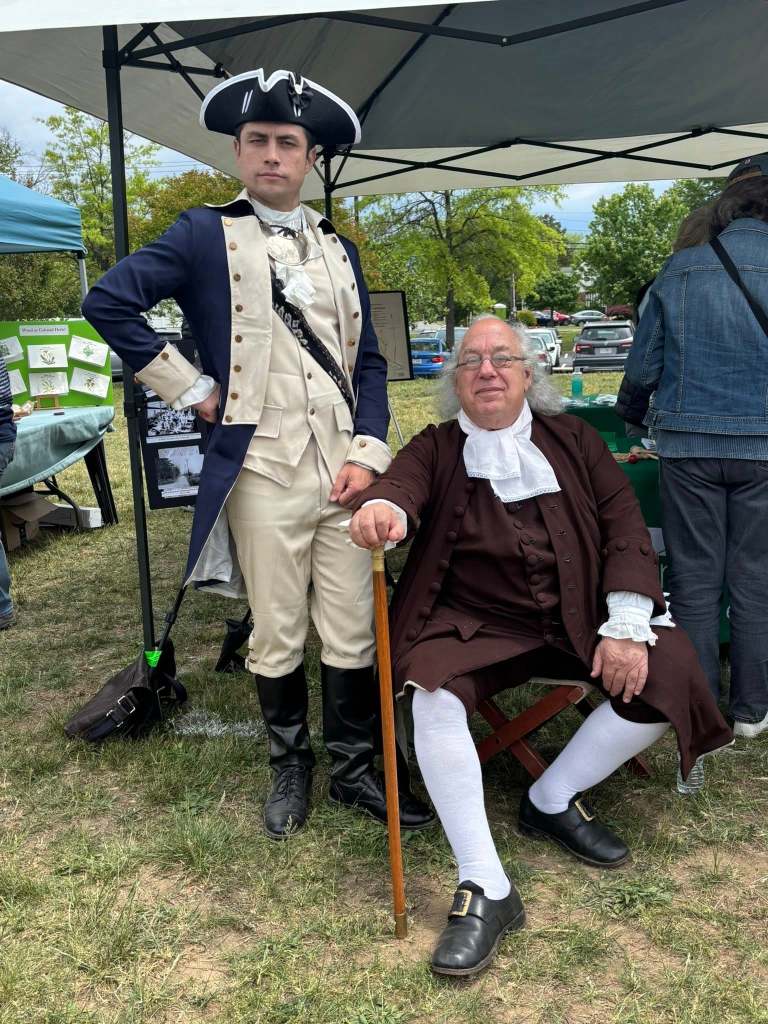
Me with Barry Stevens, noted Ben Franklin interpreter–
“A few insights on today, and as I do more gigs like this I will probably develop them further:
1) never underestimate how little the general public knows about history. I had sort of imagined having to be ready with detailed campaign strategy and political history, so I’d spent the past week reviewing stuff on Hamilton’s role on Washington’s staff, timeline of the Continental Army’s campaigns, contents of his writings then, etc. But most people, upon finding out I was Hamilton, asked me about a) duels (which I renounced) b) my wife (who I have not met yet) c) being on the $10 bill (the existence of which I did not yet know) and d) rapping in Hamilton the Musical (which, you know…)
It’s interesting how to work with this stuff. I learned from George Washington many years ago, when I trolled him hard at Mount Vernon, that when asked about the musical you can just express confusion and talk about how you have friends with law offices on Broadway and you have rapped at many doors to gain entry etc. The five dollar bill was a good chance to complain about the mismanagement of revolutionary finance by Congress (“not worth a continental.”) The wife thing was a great chance to pretend to be charming and talk about the social life of young officers; and dueling was a good chance to complain about duels. None of these were about Hamilton himself, which was interesting and affirming.
On the other hand, biographical-specific questions were interesting to work with. I told people about how close Hamilton was as aide-de-camp to Washington, and portrayed his presence here as an inspection tour of the southern American lines. I got to do the political history thing by talking about the Continentalist essays (proto-Federalist Papers Hamilton was writing during the war.) Remember, when you’re portraying a character, you’re not just talking about them; you’re engaging inside their world, as them. The British are always on the other side of the hill; American freedom is not assured. To get back into that mind is fascinating, and that’s not the stuff I got asked very often, and I’m not sure how much it was what anybody wanted, but I did find it helpful for feeling more like Hamilton than myself and hopefully giving that off. I don’t know to what degree that actually works.
2) never underestimate how much the general public cares about history. I found that lots of people wanted to pry deeper into the above sorts of things when we got talking about them, for example.
More importantly, I spent some time at the 1st Virginia’s encampment, and their purpose at these is mostly demonstrating drill and weapons cleaning etc. to people, sometimes talking about revolutionary war tactics, and all that. So I saluted them coming in and stayed at their site for a while, and there were a lot of people— especially smaller children— who came up asking about camp life and tactics and other things out of the blue.
And there’s always a sort of civic undertone to this stuff, with people clearly interested in implications for real politics and citizenship etc etc etc. I’ve mostly seen reenactors recite modern platitudes for this (in large part, I think, because 18th century political language on this subject is difficult even for historians to understand) but the fact that you need to have a response prepared just goes and affirms something that I think is so, blatantly obvious: history matters to the majority of people as a reminder of who they are and how they should behave, even and especially in its simplest versions. The fact that the characters in that history are mythic rather than relatable creates a distance between them and the average person that reinforces that identity question; and reenactment at best brings those figures closer to real life, closer to people being able to relate to them. I’m not sure what the mechanism of civic education/inspiration is on that, but I’m mulling and it’s interesting.
3) anachronism is really interesting to deal with. One of the interesting interpretation issues reenactors deal with is whether they should portray their character over the course of their whole life, or their character at a specific moment of their life (ie, the Hamilton of the Revolution, who does not know about the Federalist Papers, the Reynolds Affair, the Burr Duel, or anything) or their character over the course of their whole life. Both of these have opportunities and challenges. If you’re the former, you have more material to work with and more to respond to. But you also wind up being kind of an exhibitionist museum exhibit, and even talking about yourself in the third person. If you’re the latter, you have to finagle the fact you only are portraying part of the legacy (how to foreshadow future life events is interesting, while still implying you don’t know your own fate) but it’s easier to be a classic character in the middle of a plot with a specific role, which takes the sorta museum set piece dynamic away. Ultimately which is best is determined by context.
Also, at this festival there were other historical figures beyond the Revolution— suffragettes, soldiers from the United States Colored Troops in the Civil War, some WWII-era jeeps, etc. How the heck is a colonial revolutionary to deal with the future???
This was actually interesting, and one of the ideas i had when portraying a very young Hamilton while one of my fellow reenactors last August was a more venerable James Monroe (in reality they were about the same age) was being a “ghost,” like interacting as that character with the whole of their life as fair game but only having the appearance at a certain point of their lives, so like Virgil in the Divine Comedy; and interacting with the future from your own perspective (“tHe FoUnDiNg FaThErS wOuLd tHiNk…”) I told the suffragettes it was good to see Abigail Adams’s letters to her husband had born some fruit. I told the US Colored Troops it was good to see my friend Laurens’s plans had come true. I told the WWII jeep guys it was affirming to see the technological and manufacturing plans I’d proposed in the Report on Manufactures were eventually taken seriously. Etc, etc, etc. Hamilton has a leg up over the other Founders on this, because more than any except Franklin, he really is a prophet of the modern world. It is a sort of challenge to do, but a very wholesome one.
4) how to be “in-character” as a historical figure is really interesting. Some characters have more famously mythic appearance than others and are thus easy to look like in an almost parodic sense— Ben Franklin, Teddy Roosevelt, and Abraham Lincoln most of all. Others have some leeway, like Washington, FDR, Grant, etc. But it still surprises me that Hamilton is like the vast majority of American historical figures in that everyone has heard his name but there’s not a common mythos of what he looks like, facially. So portraying Hamilton, you have to go entirely on body language and vocal performance, because even if you did like him, you’d still need to explain who you were.
I have Hamilton’s nose and sloping forehead, a better jawline and a worse chin. Most importantly, my hair does not and never will grow the way his did, so I can’t wear it in a queue and powder it like his; i have to rely on that single manual that said officers could wear their hair cropped close to your head. All of which is to say, I can’t pose as Hamilton, so I have to impersonate him.
The fact that we don’t have physical recordings of his style is both good and bad, as is the fact that the descriptions in the public mind are pretty open-ended. You have less to mimic, but more to create; less stuff you can directly copy, but more stuff you can shape how you want. Which is to say that if you know a character well enough— and I’ve spent around 12 or 13 years with Hamilton— you can channel the parts of your personality like theirs into your performance, while suppressing the parts unlike theirs (or consciously changing them in the act.) You are always both yourself and them, you can’t stop being yourself; the trick is to channel yourself into them (and it’s been fascinating to watch people do this.)
I am really not good at this yet, and my impression is heavily reliant on being able to compose walls of words quickly, and be generally amiable; but I can’t do his seriousness or force right. That doesn’t matter quite as much for brief engagements with individuals in a crowd, but it does for sustained stuff with other characters or in front of people. I hope eventually I’m able to leave people with the impression that they actually just saw Alexander Hamilton (and I’ve known Washington’s and TRs like this) but that will be a while.
Sort of related, there seems to always be a natural habit by good reenactors to be funny, at least in small doses. One result of this is relatability so greater ease of attention. I am finding myself wondering to what degree it diminishes authenticity or not; Franklin, Lincoln, and TR had legendary senses of humor so their reenactors doing it is entirely realistic; but should Hamilton, who is said to have been witty but not funny, do the same? What if by being more realistic you become less relatable or less easy for people to be interested in? Etc etc etc.”


You must be logged in to post a comment.