A 25th Anniversary Meditation
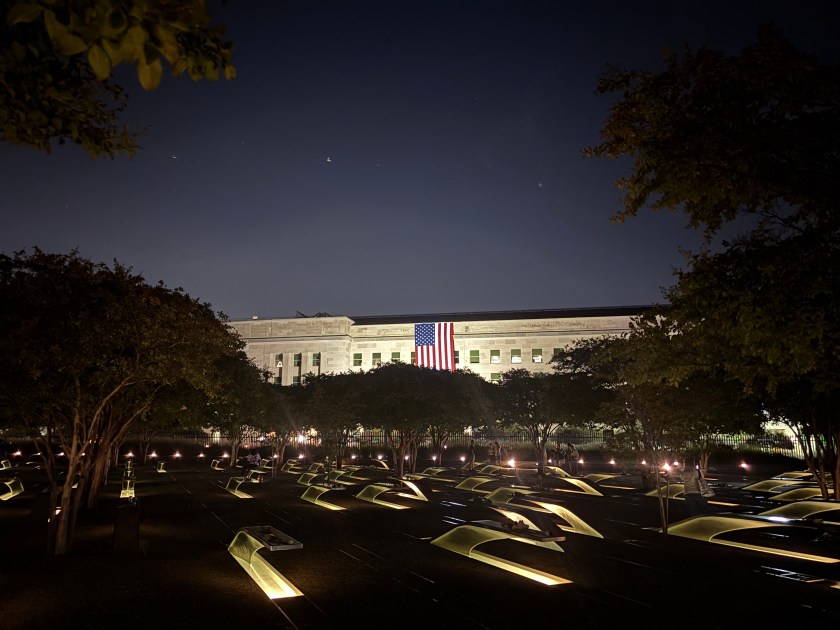
Arlington is commonly thought of as hallowed ground because of Arlington National Cemetery, and that’s true enough. But right across the highway from the cemetery—and when the highway’s closed for the marathon, you can cross from the gate of one to the gate of the other—is another somewhat more literal piece of hallowed ground, not where the dead rest, but where the dead died. The 9/11 Pentagon Memorial is less well-known than its sister in Manhattan, its story less remembered than the Battle of Flight 93. The people who died in the Pentagon were military and government personnel—slightly more legitimate targets according to the laws of war, I guess, in that war that was not a war—but they died as innocent as any others of the 3,000, and these ones died in the heart of the capital, the symbol of the Republic itself. And even as D.C. mourned the towers and the flight, more of D.C. and Virginia knew the Pentagon’s dead than the others. They were among that classic class of DMV residents, the defense community, here on tour on their long careers in quiet public service.
So it is altogether fitting and proper that the 9/11 Pentagon Memorial now finally joins Gettysburg and Yorktown and Valley Forge and Appomattox and the Little Bighorn and Fort Necessity and Manzanar and Pearl Harbor and the little field in Shanksville and all those other sacred plots, America’s hallowed grounds of heroes, where the ghosts of those who fought or suffered or died there walk and breathe, protected by the National Park Service forever. It’s an Affiliated Area rather than a park, managed by its present foundation and the DOD, but eventually it’ll become a full-fledged National Memorial, I am sure. But we’ve finally recognized it for what it is and institutionally linked it up to everything else, on its quarter-century anniversary.
Arlington is a part of the region I call home, incidentally roughly the swathe of America between the Gettysburg and Yorktown areas. We lived there in 1993, and we returned in 2024. We weren’t there in 2001—my dad was called to war that day from Norfolk, not the Pentagon—but like everything around here, memories of things we saw and things we didn’t see blur into one big hazy thing. Arlington doesn’t look like it, but if you know how to stay quiet and find it, you can feel the spirits lingering beneath the bustling shiny buildings of the contractors and the G-men and all our fellow ants of Washington. The spirits of that day, the spirits of the wars that followed, the spirits of the men and women who paid for it, the fruits of 9/11. And at the end of the day this place is a great big avoidance of that one unanswerable question—what was it all for?
That event was all the more tragic because it wound up being meaningless, at the largest sense on the national and world stage.
That’s not to say there wasn’t any meaning further down—a lot of Americans individually and communally made meaning in it in the days and weeks and years afterward—and there’s never been a shortage of invocations of 9/12, and of the uncommon kindness and generosity of the American people to each other for weeks afterward, and of the heroism of so many ordinary people that day, and of the dedication of the thousands who changed their careers at the end of 2001 to so many kinds of public service. Some enlisted and became better men and women for it, and a lot of them died in places they did not know. Like those sent to Vietnam, they did not fight in wars known for battlefield heroics and conquests; they fought in wars where the valor was less in killing terrorists, and more in unthanked suffering and death in the inglorious rubbles and deserts we all saw on TV, and their glory was more literally the “ultimate sacrifice” thing than the glories of other generations who’d had the satisfaction of raising flags on fields and cities; their pride was in service, less than in victory. Others left cushy jobs to work for no money at nonprofits they founded, or used their positions and power to bring people together across the divides they were living in, or diverted their studies from something lucrative to something for the country alone, nonprofits and bridgings and studies for public service and a thousand kinds of patriotism. Some even ran for public office, probably the last generation to do that en masse all for the best of reasons. That generation were better patriots than they’d been, better patriots than most of us have bothered to become, better patriots than most of us remember. When I’ve asked them their life stories, I’ve been shocked at how much they lost, across the board, yet how much they gained in that very loss. And the military and intelligence communities most of all.
The rise of many patriots for many kinds of patriotism, of course and always. But national purpose, national solidarity, national unity? Where?
For those of us who were very young, the shadow was indirect, but real. 9/11 formed the lives of us military kids of the Millennial generation, and we didn’t know it at the time, but we were living through something strange. It sent our moms and dads to war. They were deployed more often and for longer than is usually the case. We sat in the teleconference rooms to talk with them live on grainy screens, we sent them boxes of candies and cards, we waived flags when the ships docked and the planes landed. (Those of us who were lucky, anyway; some kids’ parents never came home.) We spent a lot of time with other kids whose moms and dads were out there, and we were in the scout troops and soccer teams on base, living our American childhoods, making new groups of close friends every other year, wondering why half the faces on TV were calling people terrorist sympathizers and the other half were calling people fascist warmongers. Some of us watched the 2007 Transformers movie by Michael Bay, and it spoke to us our pride in what our parents were doing overseas. That was our world. We were proud of our parents’ service; we still are.
I don’t think that world was fake, by any means. But beyond it things were getting weird. All the other Millennials who grew up in the 1990s and 2000s without having parents serving overseas still experienced the shadow of 9/11—always an indirect shadow, but a very long and very dark one, the kind that stretches to the horizon from a mountaintop right as the sun’s about to set and the sky’s about to fade to gloom. It was the shadow of the politics that 9/11 midwifed to our world.
I have, for almost a decade, explicitly denied the contention that 9/11 was THE seminal event of our lifetimes, given all the other whacky stuff that’s gone on since the 90s; and the 90s themselves were far, far more divided and angry and even violent than many of us remember. I’d thought the post-Cold War was defined by a mix of things, and that 9/11 and the wars were just one. But I’ve finally had to concede that it was the event that broke the spine of a dying order. The America of the 90s and the world order of the 90s doubtless would’ve slid into decay as all successful societies let themselves do, at their ends of history. But the shock of the moment unlocked the latent American habit of messianic overreach—fear and rage transformed into ambition to make the world over again, channelled into two wars fought nobly and waged horribly, wars whose beginnings cracked the faith of the world in America, and whose interminable meanderings cracked the faith of the American people in their own system. The myth of American progress and benignity, always fragile, began its long death somewhere in the desert between Fallujah and Abu Ghraib. The myth of a happy convergence of world leadership, domestic prosperity, and cultural flourishing stewarded by a benevolent and well-educated professional elite, never deep, began its long death sometime after Colin Powell made the speech he’d regret forever. Faith in America by the free peoples of the world, and faith in our leaders by the free people of America, has lingered here and there for the past quarter-century. But it has slowly and then quickly receded, and has never been restored.
And when this faith died, things went crazy. I need not catalogue the fracturing, unbalancing, and less-than-ideal rebalancing of the world order that followed our abdication of the hard-to-do-but-manageable-and-respectable role of world secretary for the pettier role of world police, and its subsequent devolutions. A brief list of our own domestic crises will suffice: the continuation of the deindustrialization of our homeland; the explosions of the financial and housing crises, and the widely-understood reality that nobody high up ever paid for them; the increasing size of our debt payments cutting off the adequate funding for basic services of our government; the failure to control our immigration system in any fair or firm way; the ascent of a techno-oligarchy whose increasing meddling in daily life was never understood or approved by the vast majority of the American people; all the fruits of underemployment, from family breakdowns to drug addictions to general senses of meaninglessness; and finally the embarrassment of the pandemic and its mishandling by our institutions. These among plenty of other things.
9/11 did not cause these. Normal countries can weather them, and we have muddled through them all. But with an elite nobody believes can be trusted, the perpetuation of these crises and spirals continues to hollow out the public trust, lower and lower and lower. That lack of trust amid these crises as the order has decayed has been the fundamental root of American politics since the 2000s. And the overreaches of the mainstreams of the parties, and the various effects of populist movements on the parties, and the gradual takeover of different parts of the parties by those populist movements, and the abject failure of any general political movement, establishment or populist, to be the most benign and productive and responsible version of itself, have clearly defined the politics of our time. I am fully convinced that the distrust that brought us here broke some dam at 9/11, and wouldn’t have come for some time after were it not for that dark day.
That conflict, that distrust, that contempt and resentment and loathing—THAT is the legacy of 9/11, not some shared national unity or American identity or collective memory. Even today, in its 25th anniversary, we beat each other over the head with its memory; I doubt I am the only one disgusted by much of what passed across my screens that Friday.
The terrorists are not relevant now. They more or less achieved their stated goal—the humiliation of America on the world stage as a spur to the toppling of the secular Arab regimes in the Middle East. We were only ever collateral damage for their real aims, and we punished the perpetrators as best we could (and then a little more.) They succeeded at something they don’t seem to have intended, though; they pushed us along in the long process of turning ourselves into our own worst enemies, into something no distraught young man in Cairo or Damascus preached at by liberals and Salafists would ever want to emulate. They have no reason to care anymore.
And we have no reason to care about them, or we shouldn’t, not if we know what’s best for us. They’ve destroyed their own civilization. We shouldn’t destroy ours (and we should be welcoming those they drove out as we work to rebuild ourselves.)
If there’s any good that comes with this day, it’s that so many of my fellow Americans convince themselves of what I myself do not believe—that there IS meaning in 9/11 beyond our national disgrace this past quarter-century, some long extension of those personal meanings found back in the autumn of 2001. Aside from some annoying and misguided folks from one hellhole accusing Muslims of not being real Americans and other annoying and misguided folks from another hellhole sneering that we deserved the bombing and deserve another one, the majority of people seem to continue to convince themselves that the memory of 9/11 has brought us together. It never really does, in actions or in words, but people continue to insist on believing that it does.
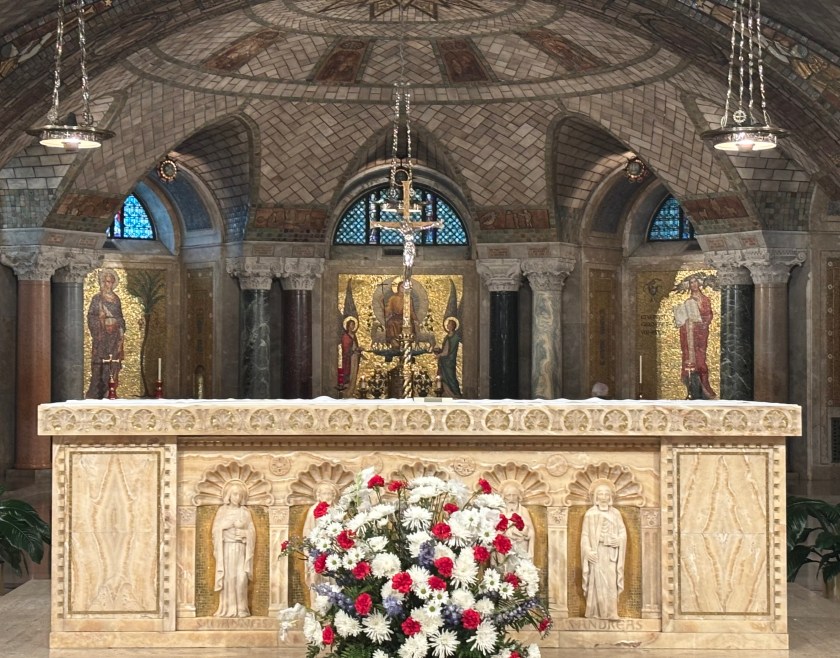
Hope springs eternal in the American soul. The mainstream of our civil religion—the bland “God Bless Americas” preached from every pulpit of every faith, God Bless Americas taken less seriously, it seems, with every passing year, God Bless Americas interpreted very differently not by people of different faiths, but always by people of different politics—remains the official mainstream, more or less unquestioned and more or less unexamined. But it remains there, officially, ready for anyone to take it up if they want. The military practices it with the most diligence and true belief. Even the bishop saying mass on Friday at the Basilica said it, in a homily for reconciliation of Americans amongst ourselves. Go anywhere all over this broad land, and you’ll find it there, glowing a little, waiting for the Fourth of July, and ready for service the next time a 9/11 comes. It’s weird. There’s always some kind of irony in American history; sometimes our self-delusions bring about our redemption, just for a moment, before we return to our typical banalities and hypocrisies and spectacles and hustles.
I have faith in America and always will (and anyone who would be a leader of any sort in this country has an obligation to have faith in America. If you do not, or refuse to pretend to, you should not be in any kind of public service, because our job is to help our fellow citizens have faith in the project, whatever it is.) If the mythos of 9/11 can someday actually move a majority of actively-moving Americans to face the same direction for just a moment, when comes some future crisis—just as the reality of 9/11 moved us to face the same direction for just a moment in the three weeks of one September a million years ago—then maybe it can help us through the present crises into a new era of our history, with new conflicts, new understandings, new ideas and identities, and the memory of a mythic moment called 9/11 seared into the American story alongside the Secession and the Depression and the World Wars and all the rest—a dark and tragic thing that launched an arc of history, redemptive at its end. John McCain called America, right before he died, “the land that repairs and reinvents itself.” It doesn’t feel like it right now; but I do believe that God uses all things for good, and all we’re supposed to do is have faith and follow, whatever that means for how we should act. And so ought we act now.
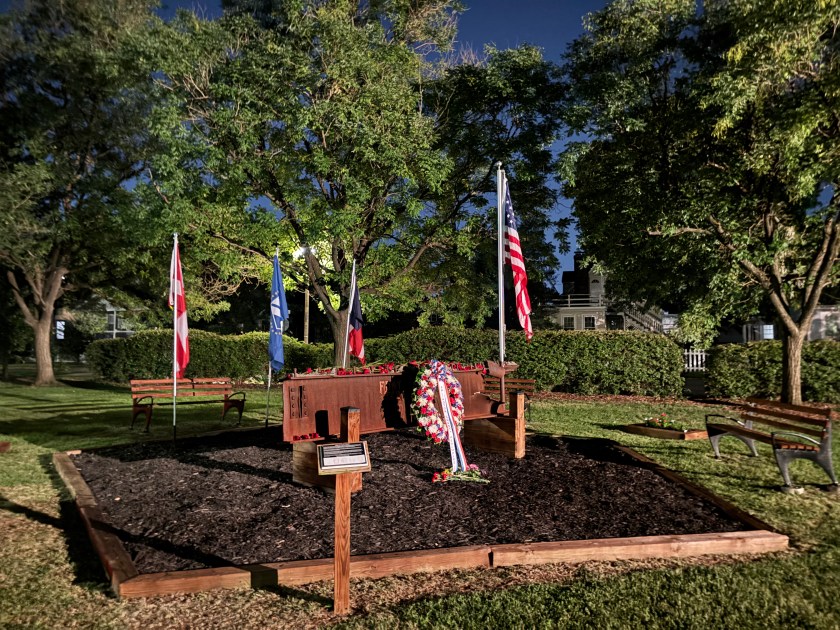
A little deeper in Arlington, there’s a little memorial even more nondescript than the one next to the Pentagon—one of the beams from the towers, surrounded by flags in a pentagon-shaped garden plot, next to the Arlington County Fire Department. It was an eagle scout project from a local troop, I believe one of the first by a female eagle scout. It just stands there quietly. The scout would’ve been born after 9/11, given the completion dates in the 2020s. 9/11 has fully and finally entered the American heritage, the American civil religion, and become a thing more remembered than present unless you try real hard to find it, and we’ll be debating its meaning alongside everything else for generations, and those debates and conflicts will shape our political identities as Americans and as a bigger America just as everything else in the American story has. That scout played a bit part in the long, ongoing process of making 9/11 a part of that bigger thing called America. Perhaps in time we’ll figure out, in everything and nothing, a little more of what it means.
-LNP


You must be logged in to post a comment.